When people discuss defensive handguns, the conversation often centers around caliber, magazine capacity, or brand reputation. Yet one of the most important factors in practical handgun performance is something far more personal: the grip.
A handgun grip directly affects control, comfort, recoil management, and consistency. In defensive situations where stress levels rise and decision-making speeds up, a stable and effective grip can make a meaningful difference in how well someone handles their firearm.
An effective grip is not about looking tactical or using the latest trend. It is about helping the shooter maintain control, align sights consistently, and operate the firearm safely under pressure.
Understanding the fundamentals of handgun grip can help both newer and experienced firearm owners make smarter decisions about training and equipment.
Why Grip Matters More Than Many People Realize
The grip is the primary connection point between the shooter and the firearm. Every movement of the handgun passes through the hands, including recoil, trigger movement, and sight alignment.
A poor grip can contribute to:
- Increased muzzle movement
- Slower follow-up shots
- Reduced accuracy
- Inconsistent recoil control
- Hand fatigue during extended practice
An effective grip helps stabilize the firearm while allowing the shooter to maintain control without unnecessary tension.
Many instructors describe grip as one of the foundational shooting skills because even advanced sights or accessories cannot fully compensate for weak handgun control.
Proper Hand Placement Creates Stability
One of the most important aspects of an effective handgun grip is proper hand placement.
In general, shooters are taught to position the dominant hand as high as possible on the backstrap while maintaining safe operation of the firearm. A higher grip helps reduce leverage from recoil and allows the handgun to track more consistently during firing.
The support hand then fills the open space around the grip panel, helping create additional stability and pressure from the sides.
The goal is balanced control rather than excessive squeezing. Over-gripping can create unnecessary muscle tension and reduce smooth trigger movement.
Grip Texture and Surface Design Matter
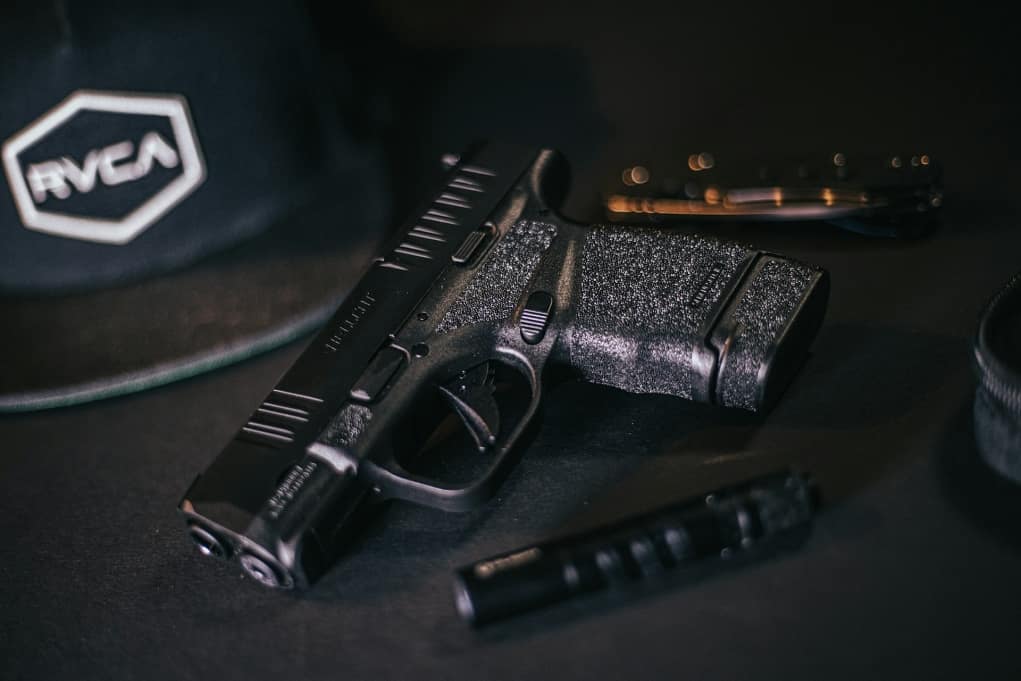
Modern handguns often feature textured grip surfaces to improve traction and control. This becomes especially important when hands are sweaty, wet, or under physical stress.
Grip texture can vary significantly between firearms. Some are smooth and comfortable for concealed carry, while others use aggressive stippling or rougher surfaces intended for maximum retention.
An effective defensive grip texture should provide:
- Consistent control without slipping
- Comfort during extended handling
- Stability during recoil
- Reliable traction in different environments
Finding the right balance is important because overly aggressive textures may become uncomfortable during daily carry or long training sessions.
Many shooters also use aftermarket grip tape or grip modifications to improve handling based on personal preference.
Hand Size and Ergonomics Play a Major Role
No single handgun grip works perfectly for everyone. Hand size, finger length, and overall ergonomics all influence how effectively someone can control a firearm.
A grip that feels excellent for one shooter may feel awkward or unstable for another.
Common signs that a grip may not fit properly include:
- Difficulty reaching the trigger comfortably
- Excessive shifting during recoil
- Trouble activating controls
- Poor wrist alignment
- Uneven pressure between hands
This is one reason many modern pistols include interchangeable backstraps or modular grip systems that allow customization.
Testing different grip sizes and frame designs before purchasing a handgun can help shooters find a more natural fit.
Recoil Control Is About Technique, Not Strength
One common misconception is that effective handgun control depends mostly on hand strength. In reality, recoil management is more closely tied to technique, grip consistency, and body mechanics.
A stable stance combined with proper grip pressure allows the firearm to recoil predictably rather than unpredictably.
Experienced shooters often focus on:
- Consistent hand placement
- Firm but controlled grip pressure
- Locked wrist positioning
- Balanced upper-body posture
- Smooth trigger control
The goal is not to overpower recoil but to manage it efficiently and consistently.
What Readers Should Understand About Defensive Handgun Grips
An effective grip is about creating repeatable control under realistic conditions.
Important concepts include:
- Higher hand placement usually improves recoil control
- Support-hand positioning adds stability
- Grip texture affects retention and comfort
- Proper ergonomics vary between individuals
- Consistency matters more than squeezing harder
- Training and repetition are essential for improvement
A good grip helps the shooter remain calm, controlled, and predictable during firearm operation.
Building Skill Through Simplicity and Practice
Defensive shooting fundamentals often come back to simple concepts repeated consistently. Grip is one of those foundational skills that influences nearly every aspect of handgun performance.
While equipment matters, technique and familiarity matter even more. A well-designed handgun paired with a poor grip can still produce inconsistent results. On the other hand, a properly trained shooter with solid fundamentals can often handle a wide variety of firearms effectively.
For anyone serious about responsible firearm ownership, investing time into grip mechanics, safe handling, and regular practice is one of the most practical ways to build confidence and control.
Sources
- National Shooting Sports Foundation (NSSF) Firearm Safety Resources
- Project ChildSafe Firearm Responsibility Information
- U.S. Concealed Carry Association Training Resources
- Federal Law Enforcement Training Centers (FLETC)
- Sporting Arms and Ammunition Manufacturers’ Institute (SAAMI)